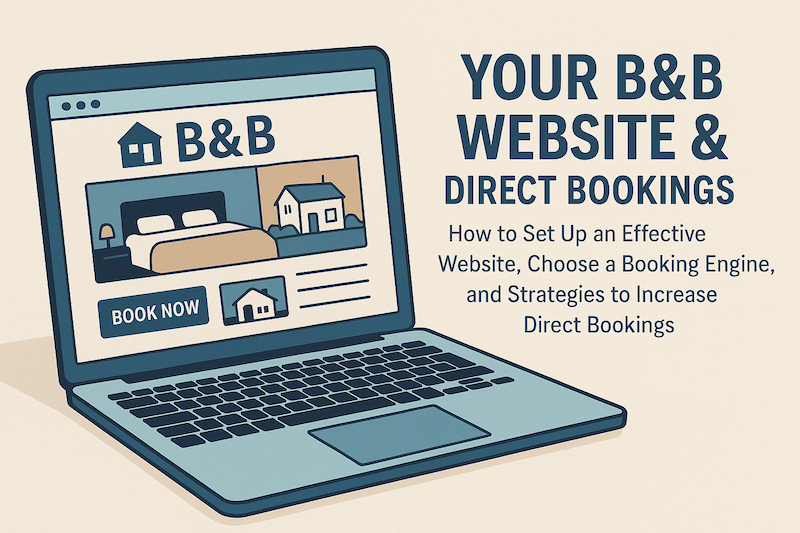
Your B&B Website & Direct Bookings: How to Set Up an Effective Website, Choose a Booking Engine, and Strategies to Increase Direct Bookings
Introduction
Launching a bed-and-breakfast website can feel daunting, especially if you’re new to digital tools. However, a well-crafted website is vital for generating direct bookings (bookings made directly with you rather than through Online Travel Agencies like Booking.com). In fact, 81% of travelers begin planning online, and over half of bookings are made directly on hotel/B&B websitesredforkmarketing.com. Every direct booking means you save on OTA commissions and build a direct relationship with your guestmews.com. In this part of our series, we’ll walk you through setting up an effective B&B website, choosing a booking engine, and proven strategies to increase your direct bookings. Let’s get started!
Choosing a Platform for Your B&B Website
When it comes to building your website, we recommend using WordPress as the platform. WordPress is one of the world’s most popular content management systems, powering a huge portion of websites todaymotopress.com. Why WordPress? It’s beginner-friendly yet extremely flexible. You don’t need to be a developer – WordPress’s user-friendly interface and wide selection of templates allow anyone to create a professional site “in no time”motopress.com. Additionally, there are countless plugins and themes (including many designed for hotels/B&Bs) that can add functionality to your site. For example, you can find hotel-themed templates and booking plugins that make accepting reservations much easiermotopress.com.
Getting Started: To use WordPress, you’ll first need to purchase a domain name (your website’s address) and a web hosting plan. Many hosting providers offer one-click WordPress installation, so you can get the site up quicklymotopress.com. Once WordPress is installed, you can choose a theme (design template) and begin adding content. Remember to pick a theme that is responsive (mobile-friendly) and fast-loading for the best results. With WordPress’s popularity and community support, you’ll find plenty of tutorials and support forums if you need help along the way. Overall, WordPress gives you full control over your B&B’s online presence without requiring advanced technical knowledgemotopress.com.
Key Design Tips for an Effective B&B Website
Your website often forms the first impression of your B&B, so good design is crucial. A professional-looking, easy-to-use site will “convey credibility and set the tone for the guest experience”mashvisor.com, encouraging visitors to stay and eventually book. Here are some key design tips to keep in mind:
-
Mobile-Friendly Layout: Ensure your site is responsive, meaning it adapts to different screen sizes (smartphones, tablets, etc.). Most travelers browse on mobile devices, so a mobile-friendly design is essentialmashvisor.comredforkmarketing.com. A responsive site is easier to read and navigate on small screens, which keeps potential guests engaged. Plus, Google favors mobile-friendly websites in search results, which can improve your visibilitymashvisor.com.
-
Fast Loading Speed: Website speed can make or break the user experience. Aim for pages that load quickly – ideally within a few seconds. Fast load times lead to higher visitor satisfaction and engagement, whereas slow pages cause frustration and drive guests awaymashvisor.com. Optimize your site by compressing images, using efficient code, and choosing reliable hostingmashvisor.com. Not only do speedy sites please visitors, they also get a boost in Google’s rankings (Google counts site speed as an SEO ranking factor)mashvisor.com.
-
High-Quality Photos: Great visuals are a must for any B&B website. Use high-resolution, professional photos to showcase your rooms, common areas, and amenities. These images serve as a “visual invitation” to guests and let them virtually experience your propertymashvisor.com. Crisp, well-lit photos of each room (and even short videos or virtual tours) help visitors imagine their stay. Ensure images are optimized (so they don’t slow down the site) but remain clear on all devicesmashvisor.com. Beautiful photos of your interiors, exterior, and local surroundings will make your site look credible and enticing.
-
Consistent Branding and Tone: Treat your website as an extension of your B&B’s personality. Use a cohesive color scheme, typography, and writing tone that reflect your brand’s style (whether it’s rustic charm, modern luxury, or quirky and eclectic). Consistency in colors, fonts, and imagery across all pages makes your B&B more recognizable and professionalmashvisor.commashvisor.com. For example, a countryside cottage B&B might use warm earth tones and friendly, casual language, whereas a chic urban inn might use sleek fonts and a more refined tone. Cohesive branding not only looks polished but also sets expectations for the kind of experience you offermashvisor.com.
-
Clear Calls-to-Action (CTAs): Guide your website visitors toward booking with prominent CTAs. A “Book Now” button or similar call-to-action should be highly visible on the homepage and throughout the sitemashvisor.com. Use contrasting colors or bold designs for these buttons so they stand out. The idea is to make it as easy as possible for guests to move from browsing to reserving. Phrase your CTAs in an action-oriented way – for example, “Reserve Your Stay” or “Check Availability” – to encourage clicksmashvisor.com. By placing CTAs strategically (e.g., on your navigation menu and after describing rooms or special offers), you ensure that the option to book direct is always one simple click away.
(Tip: Also pay attention to simple navigation and readability. Keep your menus straightforward so users can find info on rooms, rates, and contact details without hasslemashvisor.com. Use legible fonts and a clean layout to avoid overwhelming visitors with clutter.)
Must-Have Pages for Your B&B Website
Beyond good design, your website needs to cover the essential information travelers look for. Make sure to include the following pages or sections on your B&B site:
-
Homepage: The homepage is your virtual front door and should make a great first impression. In a quick glance, it should convey your B&B’s unique charm and invite visitors to explore further. Include an eye-catching hero image (perhaps of your prettiest room or a welcoming exterior shot), a brief welcome message or tagline, and a clear call-to-action (like a Book Now button front-and-center)redforkmarketing.comredforkmarketing.com. The homepage can also highlight key selling points – for example, “Award-winning breakfast,” “Steps from the beach,” or anything that makes you stand out. Remember, the goal is to entice visitors to learn more rather than overwhelm them with text.
-
About Us: Travelers love to know the story and people behind a B&B. Use an About Us page to introduce yourself (the host/owners), the history of your property, and the values or mission that guide your hospitality. Sharing a bit of personality helps guests connect with you before they even arriveredforkmarketing.com. Keep the tone friendly and authentic – you might mention how you started the B&B, any interesting historical facts about the house, or your passion for hospitality. A few photos of you, your family, or the team and property can add a personal touch.
-
Rooms & Rates: Create a page (or section) dedicated to your accommodations. If you have multiple room types, consider a main Rooms page that gives an overview of all options (with thumbnail images and brief summaries), each linking to a detailed page for that room or unitq4launch.comq4launch.com. For each room, provide a description, plenty of photos, amenities included, occupancy limits, and the rate or price range. Make it easy for guests to see what you offer and to compare rooms. This page should ideally connect to your booking engine or have an availability calendar so guests can move straight from browsing a room to booking it.
-
Booking Page / Reservations: If your booking engine isn’t embedded directly on your Rooms pages, have a straightforward Reservations or Book Now page. This page would feature your booking engine interface – typically a form or calendar where guests enter their desired dates, number of guests, etc., to check availability and rates. The booking process should be simple and secure, allowing people to reserve a room in just a few stepsmylighthouse.com. Make sure it’s clear that the page is secure (use HTTPS/SSL and display trust signals if possible) since guests will enter personal and payment info. Note: Many B&B websites integrate the booking function such that the “Book Now” button opens a booking widget or redirects to a secure booking portal. Whether it’s a separate page or a pop-up form, test it to ensure it’s user-friendly.
-
Contact Us: Always provide an easy way for potential guests to reach you. The Contact page should list all relevant contact info – phone number, email address, and the B&B’s physical address. It’s also a good idea to include a contact form that visitors can fill out with inquiriesq4launch.comq4launch.com. Additionally, you might embed a Google Map showing your location to help guests visualize where you are. Make sure this page is clearly linked in your navigation menu (and footer) so no one has to hunt for it. Prompt, easy communication builds trust, so don’t hide your contact details.
-
Local Guide / Things to Do: Guests will be interested in the area around your B&B, so dedicate a section to local attractions. This could be titled “Things to Do,” “Nearby Attractions,” or “Local Guide.” Provide recommendations for restaurants, sightseeing spots, parks, events, or insider tips about your regionq4launch.com. Not only does this add value for your guests (helping them plan their trip), it also shows that you as a host are knowledgeable and excited about your locale. You can include brief descriptions or even a blog-style list of your favorite local places. If you offer any special packages or partnerships (e.g., a discount at a local spa or winery), mention those here for added incentiveq4launch.com.
-
Blog (or News & Updates): While not strictly required, a blog can be a powerful addition to your B&B website. Through blog posts, you can share travel tips, B&B news, upcoming local events, or stories about your property. This keeps your website content fresh and gives visitors more reasons to stay on your site. Importantly, blogging can boost your SEO: posting “informative, keyword-rich content” about your area or hospitality tips can help attract more organic traffic from search enginesredforkmarketing.com. For instance, a blog post on “Top 5 Hidden Gems to Explore around [Your Town]” might draw in readers (and potential guests) searching for local info. If you decide to have a blog, aim to update it periodically and keep the topics relevant to your audience (travel and your region). It’s also a chance to showcase your expertise as a local host.
(Other pages you might consider include a Photo Gallery (if you want to share additional images beyond what’s on the Rooms pages) or Testimonials/Reviews page to highlight guest feedback. However, you can also integrate testimonials onto your homepage or sidebar for visibility. The key is to cover the basics above so guests find all the info they expect.)
Booking Engines and Your PMS: Enabling Direct Online Bookings
One of the most important components of a direct-booking website is the booking engine. For those new to the term, a booking engine is the software (often a plugin or third-party tool) that powers online reservations on your site. In other words, it’s the mechanism that lets a guest check room availability, select dates, and confirm a booking directly on your websitemews.com. You can think of it as your digital reservation desk or “online front desk”hotelminder.com.
How It Works with a PMS: Most B&Bs use a Property Management System (PMS) to handle reservations, calendars, and guest data. An ideal setup is to have your website’s booking engine integrated with your PMS. Integration means that when a guest books through your site, the reservation is automatically recorded in your PMS and your availability is updated across all channels. This prevents the nightmare of double-bookings and keeps inventory accurate in real timehotelminder.com. As one guide puts it, “ensure your website has a booking engine integrated with your PMS so you can manage bookings seamlessly across the guest journey”mews.com. In practice, many modern booking engines connect not only to your PMS but also to your channel manager (if you use one to distribute rooms on OTAs), synchronizing everything. The takeaway: choose a booking engine that plays nicely with your existing systems. It should at minimum support two-way integration with your PMS or channel manager to automatically block off dates when a room is bookedhotelminder.commews.com.
Choosing a Booking Engine: Not all booking engines are the same. Here are a few factors to consider when selecting the right one for your B&B:
-
Ease of Use (Guest Experience): The booking process should be quick and user-friendly for your customers. Look for a booking engine that allows guests to “check availability and reserve their stay in just a few simple steps.”mylighthouse.com A cumbersome or confusing interface will cause users to abandon the booking. Test any solution from a guest’s perspective: is it mobile-friendly (can someone easily book from a phone)? Is the calendar or form intuitive? Ideally, it should require minimal clicks from selecting dates to entering details and confirming. Many booking engines offer demo modes – take advantage and try them out before deciding.
-
Integration & Compatibility: As mentioned, seamless integration with your PMS is crucial. Verify that the booking engine you consider is compatible with your PMS (or any channel management tool you use). A well-integrated engine will ensure “real-time inventory updates” and eliminate manual data entryhotelminder.comhotelminder.com. Additionally, check if it supports integration with other tools you might need (for example, payment gateways for processing credit cards, or automated email systems for sending confirmations).
-
Secure Payment Processing: Security is non-negotiable when handling online bookings. A good booking engine will include a secure payment gateway or support popular payment processors. It should enable guests to safely enter credit card details or pay deposits, with SSL encryption and compliance with security standards. Look for indications that the provider is PCI-compliant (the standard for credit card security). Also, consider whether it offers multiple payment options (credit/debit, PayPal, etc.) to accommodate different guest preferencesmylighthouse.com. Offering a variety of payment methods can reduce friction at checkout.
-
Cost Structure: Booking engines typically charge either a commission per booking, a flat monthly fee, or sometimes a mix of both. For a small B&B, a commission-based model (e.g., paying 1-3% per booking) might be appealing if your volume is low or seasonal, since you pay only when you get bookingshotelminder.comhotelminder.com. Larger properties often prefer a fixed monthly subscription for predictability. Be sure to compare pricing models: the “cheapest option isn’t always the most cost-effective”, especially if a slightly pricier engine converts more lookers into bookershotelminder.com. Some booking engines are bundled with a PMS (or come as part of a B&B management software suite), which could be economical. In short, choose one that fits your budget but also delivers the features and reliability you need.
-
Features and Extras: Finally, consider any extra features that might benefit you. For example, can the booking engine handle promotional codes or special rates (useful for offering a discount to direct bookers)? Does it support multiple languages or currencies if you cater to international guests? How about the ability to sell add-ons (like packages or upsells during the booking process)? Some modern booking engines even have built-in tools for upselling or remarketing. Make a list of “must-have” features (e.g., sync with Airbnb/OTA calendars, or an ability for guests to select specific rooms) and use it to compare providers. Also, read reviews or ask for recommendations from other hosts if possible.
Once you’ve selected a booking engine, the setup process usually involves configuring your rooms/rates in that system and then embedding the booking form or button on your website. Many booking engines provide a simple widget or WordPress plugin for integration. Don’t forget to test your booking engine thoroughly after setup: simulate a booking on desktop and mobile to ensure everything works and that confirmation emails are received. This is the core of your direct booking system, so it’s worth getting it right!
Strategies to Increase Direct Bookings
With a solid website and booking engine in place, the next step is to actively encourage guests to book direct. Here are several strategies – explained in non-technical terms – that will help you capture more direct bookings and rely less on OTAs:
-
Use Clear “Book Now” Calls-to-Action: As touched on in design tips, make sure your site constantly invites the booking. Prominent “Book Now” or “Check Availability” buttons should appear in high-visibility areas – think header navigation, the top of the homepage, and at the end of each room descriptionmylighthouse.com. The idea is that no matter what page a visitor is on, they’re one click away from your booking engine. Effective CTAs are typically brightly colored or styled to grab attention, and use urgent, action-oriented language (“Book your stay” instead of a bland “Submit” button)mashvisor.commashvisor.com. By guiding visitors with unmissable buttons and links, you reduce the chance they’ll drift away to an OTA.
-
Offer a Best Price Guarantee: Savvy travelers often compare prices between your website and OTAs. Encourage them to book direct by guaranteeing the best price on your site. For example, you can promise to match any lower rate found elsewhere, or simply ensure your direct rate is a bit cheaper since you’re not paying OTA commissions. Advertising a “best price guarantee” instills confidence that guests won’t find a better deal by going to another sitemews.com. You can display a message like “Book direct for the best rate – guaranteed!” on your homepage and booking page. Just be prepared to honor it (which usually means keeping your rates consistent or slightly lower on your own site). This strategy plays to the price-sensitive guest and removes a key reason they might choose an OTA (price differences).
-
Provide Direct Booking Perks: Apart from price, think about extras you can offer exclusively to direct bookers. Since you’re saving on OTA fees, you can afford to add value for those who book through your website. Examples include a complimentary welcome drink, free breakfast, free parking, a small gift basket, or a room upgrade when available. Even non-monetary perks like flexible check-in/out times or a free local tour map can sweeten the deal. Emphasize these benefits on your site – e.g., “Direct bookings get free continental breakfast!” Such “exclusive offers for guests who book directly” are great incentivesmews.com. They make guests feel they’re getting something special and encourage loyalty. Choose perks that won’t cost you too much but are perceived as valuable to visitors.
-
Showcase Guest Reviews and Testimonials: Trust is a big factor in the decision to book. Include some positive guest reviews or testimonials on your website to build credibility. You might have a dedicated Testimonials page or sprinkle quotes from happy guests throughout the site (with permission, or by embedding reviews from TripAdvisor/Google if allowed). Seeing real feedback (e.g., “The rooms were spotless and the homemade breakfast was amazing!”) can reassure potential guests that your property is as good as it sounds. Strong reviews “boost confidence among potential guests”, making them more likely to book with you directlymews.com. Additionally, respond to reviews on external platforms – it shows you care about guest experience. You can even highlight that by saying, “Rated 4.8/5 by our guests” or displaying a badge if you have one (like TripAdvisor Certificate of Excellence). Social proof goes a long way.
-
Leverage Upselling and Packages: Direct bookings give you the opportunity to upsell extras during the booking process. OTAs often limit how much you can customize add-ons, but on your own site you can offer special packages or enhancements. For instance, allow guests to add a romance package (flowers and wine on arrival), book a local tour through you, or upgrade to include dinner. Integrating upsells in your booking engine can both increase your revenue and enhance the guest’s staymews.com. Just make sure any add-ons are relevant and reasonably priced. You can advertise packages on your site (like a seasonal “Winter Getaway Package”) and ensure that they are only available when booking direct (which you can mention as another perk). Upselling, done tastefully, not only earns you more but also gives guests a fuller experience – a win-win.
-
Encourage Newsletter Sign-ups (and Follow Up): Not every visitor to your website will book on their first visit. To capture those “maybe later” guests, include a way for them to subscribe to your newsletter or mailing list. A simple email sign-up form with an inviting call-to-action (e.g., “Get our local guide and special offers – subscribe here”) can help build your email list. Offer an incentive for signing up, such as a small discount on the first booking or a free PDF guide to your city’s attractions. By “collecting opt-in emails” from visitorsblog.thehotelsnetwork.com, you create a pipeline to market to them in the future. Once they’re on your list, you can send periodic emails: maybe a seasonal promotion, a newsletter with B&B updates or area events, or a returning-guest special. Email marketing is a powerful direct tool – for example, sending a promo code for 10% off a future stay can nudge past guests to book again directly. Just be sure to not spam and always provide value in your emails (so people stay subscribed). This strategy focuses on building a relationship that can lead to direct bookings down the line.
(Remember: The overarching theme of these strategies is to make booking direct more attractive and convenient than going through a third party. Keep emphasizing the benefits – whether cost savings, special perks, or the simple ease of dealing directly with the friendly host (you!). Over time, as you implement these tactics and perhaps gather feedback, you’ll find the right mix that works for your B&B.)
Basic SEO Practices for Your B&B Website
Finally, a quick word on Search Engine Optimization (SEO) – the art of making your site visible on Google and other search engines. You don’t need to be an SEO expert, but following a few basic best practices will help more travelers find your website when searching for accommodations in your area. Here are the SEO basics you should cover:
-
Use Proper Headings: Structure the text on each page with heading tags (H1, H2, H3, etc.) to make it easy to read. Each page should have a single H1 heading (usually the page title) that tells what the page is about. Then use H2 subheadings for main sections, H3 for subsections, and so on. This hierarchical structure not only improves readability but also helps search engines understand your content. For example, your Rooms page might have an H1 like “Our Accommodations,” with H2 subheadings for “Deluxe Suite,” “Garden Room,” etc. Keep headings descriptive and include keywords where it makes sense (e.g., “B&B Amenities” instead of just “Amenities”). Using clear headings is part of basic on-page SEOmylighthouse.com – it signals to Google what each section of your page covers, and it helps human readers scan your page quickly (many people skim by headings).
-
Meta Titles & Descriptions: For every page on your site, define a meta title and meta description. The meta title is the page title that appears in search engine results and at the top of the browser tab – it should be concise (50-60 characters) and include your B&B name plus a keyword or two (for instance, “Sunnyvale B&B – Cozy Bed and Breakfast in Vermont”). The meta description is a short snippet (about 150-160 characters) that appears below the title in Google results. Write a compelling meta description for each page that summarizes what the page is about and entices people to click. For example: “Charming 5-room B&B in [Town]. Spacious en-suite rooms, homemade breakfast, and mountain views. Book direct for best rates!” This tells both search engines and users what to expect. Crafting unique meta titles and descriptions is a basic SEO checklist itemmylighthouse.com and can improve your click-through rate from search results.
-
Alt Text for Images: Search engines can’t “see” images, so we have to help describe them. For every photo on your site, fill in the alt text (alternative text) field with a brief description of the image. For example: alt text for a room photo might be “Deluxe Suite bedroom with king bed and balcony view.” Alt text serves two purposes: it makes your site accessible to people using screen readers (important for ADA compliance) and it gives search engines context about the image contentredforkmarketing.com. It might slightly help you show up in image search results as well. Keep alt descriptions simple and accurate – describe what’s in the picture as if to someone who cannot see it. This is an easy SEO win that many beginners overlook.
-
Other SEO Tips: Ensure your site is secure (HTTPS) – which it should be if you have a proper SSL certificate, as this is a Google ranking factor and builds user trustredforkmarketing.com. Also, try to incorporate relevant keywords naturally in your site content: think about what your potential guests search for (e.g., “bed and breakfast in [Your City]” or “romantic B&B [Region]”) and include those terms in your headings and body text where appropriate. Registering your property on Google Business Profile (formerly Google My Business) is highly beneficial too – it helps you appear on Google Maps and local search results, and you can link your website theremylighthouse.com. Lastly, maintaining a blog (as mentioned) with local travel content can improve SEO by capturing long-tail searches and keeping your site active. While SEO can get very deep, these basics – good content structure, meta tags, alt text, fast load times, mobile optimization – will set you on the right path. And they’re all things you can manage without technical expertise.
Practical Checklist: Building an Effective B&B Website for Direct Bookings
To wrap up, here’s a handy checklist summarizing the key steps and best practices discussed:
-
Secure a Domain & Hosting: Choose a short, memorable domain name (ideally including your B&B name or location) and sign up for a reliable web host. Install WordPress on your hosting server (many hosts provide one-click install)motopress.com.
-
Install WordPress & a Suitable Theme: Set up WordPress and pick a mobile-friendly, fast theme (possibly a hotel/B&B-specific theme) that matches your brand’s style. Ensure the site layout is responsive and looks good on all devicesredforkmarketing.comredforkmarketing.com.
-
Create Essential Pages: Build out the key pages – Homepage, About Us, Rooms/Accommodations (with details and rates), a Booking page or integrated booking section, Contact Us, and a page for local attractions (Things to Do). Populate each with engaging, accurate content and great photosredforkmarketing.comq4launch.com.
-
Integrate a Booking Engine: Choose a booking engine solution and connect it to your website. Make sure it’s integrated with your PMS for automatic calendar updatesmews.com. Test the booking process end-to-end to verify it’s simple, secure, and working properly (including payment processing and confirmation emails).
-
Add Clear Calls-to-Action: On every page, especially the homepage and room pages, place prominent “Book Now” or “Check Availability” buttons/linksmylighthouse.com. Use a contrasting color so they stand out, and link them directly to your booking engine or reservations page.
-
Optimize Site Speed & Mobile Usability: Compress images (without sacrificing quality) so that each file is reasonably small (under ~1 MB)mylighthouse.com. Minimize any unnecessary plugins or scripts. Test your site’s loading speed and mobile display – fast load times and a smooth mobile experience will keep visitors on your sitemashvisor.commashvisor.com.
-
Show Trust Signals: Include some guest testimonials or ratings on your site to build credibility. Also ensure your site uses HTTPS (secure lock icon in browser) to protect user dataredforkmarketing.com. If applicable, display badges or associations (like B&B associations or awards) to reassure guests that your business is legitimate.
-
Highlight Direct Booking Benefits: Clearly mention any direct booking advantages – e.g., “Book direct for the best price and a free welcome drink!” This messaging can be in your site banner, on the booking page, or as a pop-up. A best-rate guarantee or exclusive perks will encourage visitors to book on your site rather than elsewheremews.commews.com.
-
Include an Email Sign-up: Add a newsletter subscription form on your site (for example, in the footer or as a lightbox popup). Offer an incentive for signing up (like a travel guide or discount) to grow your email list. This lets you follow up with potential guests via email and promote future deals or newsblog.thehotelsnetwork.com.
-
Implement SEO Basics: For each page, set a unique meta title and description that contain relevant keywords (like your location and property type)mylighthouse.com. Use heading tags (H1/H2, etc.) to structure your content, and fill in alt text for all images describing what’s shownmylighthouse.com. These steps improve your chances of appearing in search results and make your site accessible.
-
Keep Information Updated: Regularly update your website content. Ensure that your rates, availability, contact information, and policies (cancellation rules, check-in times, etc.) are all current. An outdated website can mislead guests or hurt your credibility. Also, periodically add new photos or blog posts to keep things fresh – search engines and users both appreciate up-to-date content.
By following this checklist and the guidance above, you’ll be well on your way to having an effective B&B website that not only looks great but also drives direct bookings. With your own website optimized and a solid direct booking strategy, you can reduce reliance on OTAs, save on commissions, and build stronger relationships with your guests from the moment they start browsing. Good luck with your website, and happy hosting!
Sources: The tips and recommendations above were compiled from hospitality marketing experts and industry guides to ensure accuracy and relevance for 2025. For further reading, see resources like Mashvisor’s design tipsmashvisor.commashvisor.com, MotoPress’s guide to direct booking sitesmotopress.com, RedFork’s B&B website guideredforkmarketing.comredforkmarketing.com, Mews’s direct booking strategiesmews.commews.com, and Lighthouse’s direct booking checklistmylighthouse.commylighthouse.com, among others, which provided insights into the best practices shared here.