
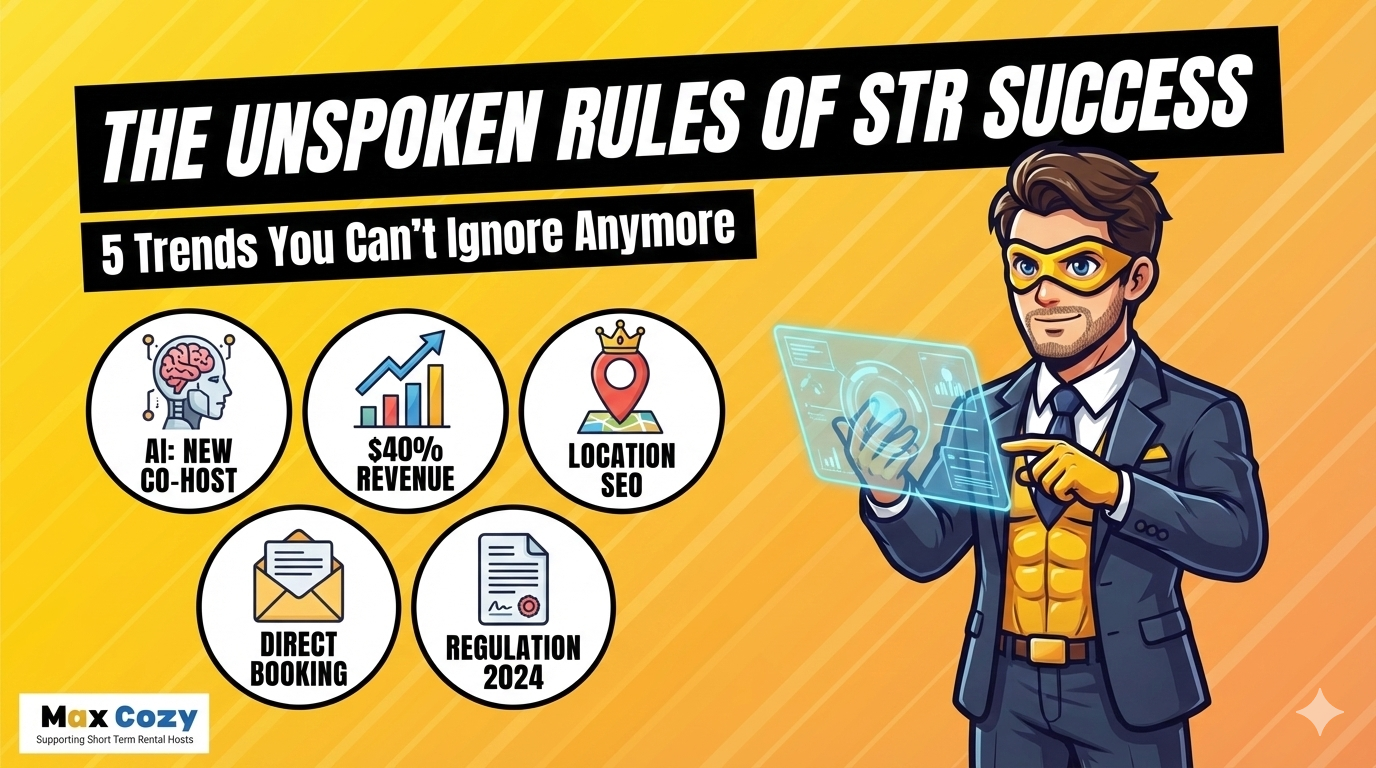
The Unspoken Rules of STR Success: 5 Trends You Can't Ignore Anymore
Managing a short-term rental (STR) in today's market can feel overwhelming. Between juggling bookings, coordinating cleanings, and responding to guest inquiries, it's easy to get lost in the day-to-day grind. The constant pressure to stand out in a crowded marketplace only adds to the challenge. But while you’re focused on the immediate tasks, the entire landscape of the vacation rental industry is quietly and rapidly evolving beneath your feet.
Success is no longer just about having a great property and providing good service. It now depends on understanding and adapting to key, often counter-intuitive, shifts in technology, marketing, and strategy. Sticking to old methods means falling behind, while embracing these changes can unlock new levels of profitability and resilience.
This post cuts through the noise. Based on a deep dive into recent industry analysis, we are revealing the five most impactful takeaways that can transform your operations. These are the trends that separate thriving businesses from those that merely survive, helping you build a more durable and profitable business for the future.
Takeaway 1: AI Is Your New Co-Host, Not Your Replacement
The AI Adoption Surge
52% of Property Managers are already using AI in their operations.
Artificial Intelligence is being adopted across the STR industry at a remarkable pace, but not in the way many hosts fear. It isn't here to replace human hospitality; it's here to supercharge it. A 2024 survey revealed that 52% of property management respondents are already using AI in their operations, signaling a major technological shift.
The primary role of AI is to automate the repetitive and time-consuming tasks that drain your energy. Think of automated guest communications for routine questions, intelligent scheduling for cleanings and maintenance, and even organizing your property photos. Airbnb’s AI-powered photo tour, which automatically categorizes images by room, is a perfect example of AI handling a tedious task to improve the guest's browsing experience. This automation frees you up to focus on high-value, personal touches that truly define great hospitality.
"AI has no possibility of doing what we do. Depending on the jobs we do, it could do 20% of our jobs 1,000 times better … but in no job can they do all of it." — Nvidia CEO Jensen Huang
The surprising truth is that far from creating an impersonal, robotic experience, AI is enabling hosts to provide **more personal** and attentive service. By letting technology handle the logistics, you can dedicate your time to what matters most: creating memorable, human-centered guest experiences.
Takeaway 2: You Might Be Leaving 40% of Your Revenue on the Table
The Dynamic Pricing Revenue Lift
Static Pricing
Dynamic Pricing
Higher Annual Revenue Potential
Many hosts fall into the "set-it-and-forget-it" trap with their pricing. They pick a nightly rate, maybe a slightly higher one for weekends, and leave it at that. This static pricing model is one of the biggest missed opportunities in the STR business. The alternative, dynamic pricing, is a game-changer.
Dynamic pricing tools automatically and continuously adjust your rates based on a host of real-time data points: market demand, seasonality, day of the week, local events like concerts or festivals, and what your competitors are charging. These systems ensure you're not underpriced during peak demand or overpriced during a quiet week.
The financial impact is staggering. Recent data shows that properties using dynamic pricing tools can earn up to **40% higher annual revenue** compared to those with static pricing.
This isn't just about earning more; it's about gaining the financial freedom to reinvest in the guest experience, creating a virtuous cycle of higher quality and higher returns.
Takeaway 3: The Smartest Marketing Isn't About Your Property—It's About Your Location
The Destination Marketing Funnel
Research (SEO Pages)
Guides, Local Tips, Events
Conversion (Bookings)
Property Listing
The common approach to marketing is to create property pages—"sell pages"—designed to convert a visitor who is ready to book. A far more powerful, yet counter-intuitive, strategy is to focus on creating "SEO pages" designed to attract travelers much earlier in their planning journey.
Instead of just selling your property, sell your destination. SEO pages take the form of valuable, informative content like blog posts or local guides. Think of titles like:
- "Top 10 Family Activities in [Your City]"
- "Best Restaurants and Attractions near [Your Property]"
- "A Complete Guide to the [Annual Local Festival]"
By creating this content, you position yourself as a trusted local expert. You capture search traffic from potential guests who are just starting to research their trip—long before they open an OTA to browse listings. This builds credibility and introduces your brand at the very beginning of the customer journey.
This strategic pivot transforms your marketing from a costly sales function into a value-driven asset that builds a loyal audience, insulating your business from the whims of OTA algorithms.
Takeaway 4: Your OTA Guests Aren't Really Your Customers
The Direct Booking Power (Email ROI)
$1
Invested
Average Return (ROI)
for every $1 spent on Email Marketing
Online Travel Agencies (OTAs) like Airbnb and Vrbo are fantastic for visibility, but they create a fundamental paradox for hosts: the guest relationship belongs to the platform, not to you. This severely limits your ability to communicate directly, access guest data for marketing, and encourage repeat, commission-free bookings. When a guest books through an OTA, they are the OTA's customer.
The solution is to build a business asset that you truly own: a direct booking channel powered by an email list of your past guests. By ethically and strategically encouraging OTA guests to join your email list (for example, with a post-stay thank you note offering a discount on their **next** direct booking), you take back control.
The power of this approach cannot be overstated. Email marketing yields an average Return on Investment (ROI) of about **$36 to $44 for every $1 spent**, making it one of the most cost-effective marketing channels available.
Ultimately, this isn't just about saving on commissions; it's about transforming a dependency into an independent asset, ensuring your business's long-term value is determined by you, not by a platform you don't control.
Takeaway 5: A Simple Number Is About to Professionalize the Entire Industry
A massive regulatory shift is underway that will fundamentally change the operational requirements for hosts. The recently passed **Regulation (EU) 2024/1028** offers a clear blueprint for what the future of STR regulation will look like globally. This signals a move toward a more transparent and professionalized industry.
The Global Regulatory Shift
1. Registration Procedures
2. Unique Registration Number
3. Mandatory Data Sharing
In simple terms, here are the key requirements this trend introduces:
- Registration Procedures: Government bodies will establish official registration systems for all short-term rental units.
- Unique Registration Number: Each registered property will be issued a unique registration number.
- Mandatory Display: Hosts will be required to display this registration number on all online listings, including on OTAs.
- Data Sharing: Online platforms will be obligated to share activity data—such as nights booked and guest counts—with public authorities on a monthly basis.
The impact of this trend is enormous. It marks the end of the informal, "wild west" era of short-term rentals. This global shift toward regulation and data transparency will require every host to focus more on **compliance, data management, and operating as a formal, professional business.**
Conclusion
The five takeaways above paint a clear picture: the short-term rental industry is maturing. The days of casually listing a spare room with little strategy are over. Success now requires a more professional, tech-savvy, and strategic mindset. From leveraging AI for efficiency and dynamic pricing for revenue, to owning your marketing channels and preparing for new regulations, the path forward is one of deliberate and informed action.
These shifts aren't just challenges; they are opportunities for savvy hosts to build stronger, more resilient businesses that can thrive for years to come. The hosts who adapt will not only survive but will define the next era of hospitality.
As the STR landscape continues to evolve, which of these shifts will you embrace first to build a more resilient business for the future?
Ready to Implement These Trends?
Step 1: Review your current pricing strategy. Are you still using static rates?
Step 2: Choose an AI tool to automate your most time-consuming task (e.g., guest Q&A or cleaning scheduling).
Step 3: Draft your first piece of local guide content to attract early-stage travelers.